
How to Teach Noorani Qaida to a Child: A Step-by-Step Guide for Parents
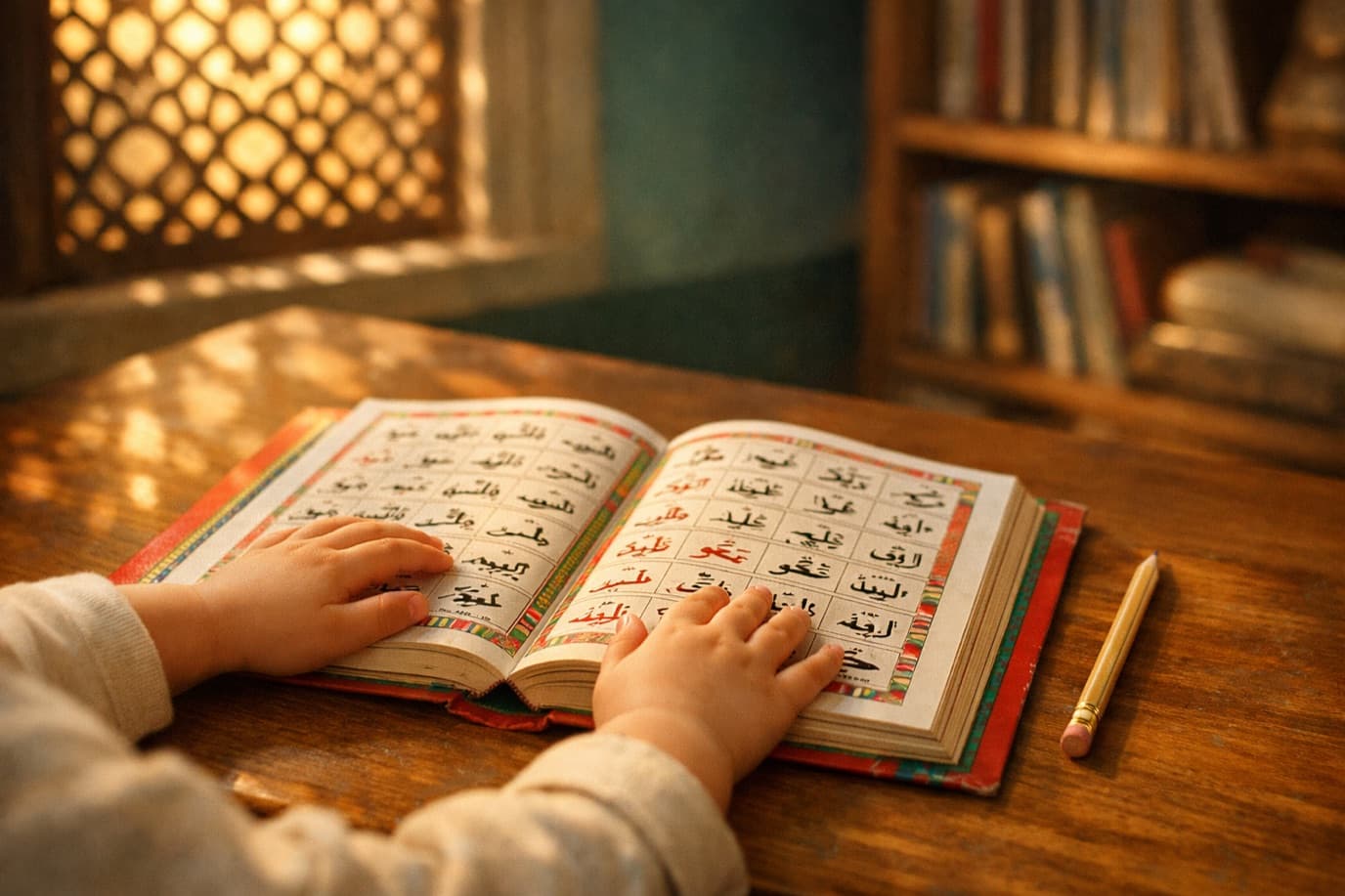
Noorani Qaida is the doorway every child walks through before they can read the Quran. Get it right and everything after it — reading, tajweed, memorization — comes far more easily. This guide walks you through exactly how to teach Noorani Qaida to a young child: where to start, what each stage looks like, how long to expect it to take, and the common mistakes that quietly slow children down.
What is Noorani Qaida?
Noorani Qaida (القاعدة النورانية) is a graded primer that teaches a child to read Arabic — and therefore the Quran — from the very first letter. It is not the Quran itself; it is the foundation course that makes reading the Quran possible.
It is built in a deliberate order: individual letters first, then their sounds, then how letters join, then vowels, then the rules that shape real recitation. Each page assumes the child has mastered the one before it. That structure is the whole point — skip ahead and gaps appear later that are hard to fix.
Before you start: what a young child can actually do
A four- or five-year-old has a short attention span and a huge capacity for repetition. Work with both.
- Keep sessions short. Ten to fifteen focused minutes beats forty distracted ones.
- Repeat daily, not weekly. Sound recognition is a habit built by frequency, not by long sittings.
- Praise effort, not just correctness. The goal at this age is a child who enjoys opening the Qaida.
The stages of Noorani Qaida
Stage 1 — The individual letters (Huroof Mufradat)
The child learns to recognize and correctly pronounce each of the 29 Arabic letters in isolation. The key skill here is makharij — producing each letter from its correct place in the mouth or throat.
Spend real time distinguishing letters that sound similar to an English-speaking ear — ع (Ayn) versus أ (Hamza), or the three "s"-like letters س، ص، ث. A child who learns these cleanly now never has to unlearn them later.
Stage 2 — Joined letters (Huroof Murakkabat)
Arabic letters change shape depending on where they sit in a word. Here the child learns to recognize the same letter in its beginning, middle, and end forms, and to read short joined combinations.
Stage 3 — Vowels: Harakaat, Tanween, and beyond
Now the letters get their sounds. The child learns the short vowels (fatha, kasra, damma), then Tanween, then the long vowels (Madd letters), then sukoon and shaddah. This is where isolated letters finally become syllables the child can blend.
Stage 4 — Rules that shape recitation
The final pages introduce the beginnings of tajweed — light and heavy letters, the rules of Noon Saakin, and stopping. By the end, the child can sound out a line of the Quran on their own.
"And We have certainly made the Qur'an easy to remember. So is there any who will remember?" — Surah Al-Qamar, 54:17
Allah calls the Quran easy — and a well-taught Qaida is how that ease reaches a child.
How long does it take?
With daily 10–15 minute sessions, most children complete Noorani Qaida in six to ten months. Some finish faster, some slower — pace is far less important than accuracy. A child who finishes in a year with clean pronunciation is in a far stronger position than one rushed through in three months with sloppy sounds.
The mistakes that slow children down
- Rushing to the next page before the current one is solid. Mastery, not speed.
- Tolerating "close enough" pronunciation. Small errors compound into stubborn reading habits.
- Teaching by name instead of by sound. A child needs the sound a letter makes to read, not just its name.
- Comparing siblings. Every child's ear develops at its own rate.
- Skipping daily practice. Two weeks off can undo a month of progress at this age.
Should you teach it yourself or use a teacher?
Many parents start Noorani Qaida at home, and that's wonderful. The difficulty is pronunciation: if you weren't taught the makharij precisely yourself, it's hard to hear and correct your child's small mistakes. That is exactly what a trained teacher does — listens in real time and corrects before an error becomes a habit.
A qualified female teacher over a live 1-on-1 class can take your child through every stage of the Noorani Qaida course at their own pace, then straight into Quran reading — with you able to sit in and watch.
Ready to see it in action? Book 2 free classes and watch your child read their first letters with a patient teacher — no card, no commitment.
Next steps
Once your child completes the Qaida, the natural progression is fluent Quran reading, then tajweed. If you'd like more on teaching young children specifically, read our parent's guide to teaching the Quran to your 6-year-old.
About the author
Hafiza Saba Waqas has memorized the entire Quran and specializes in teaching tajweed and Quran reading to children. She teaches 1-on-1 online with Quran Interactive in English, Urdu, and Arabic, and is a favourite among parents of young learners.
→ View profile · Book a trial with Hafiza Saba
Ready to start?