
Teaching the Quran to Your 6-Year-Old: A Parent's Guide
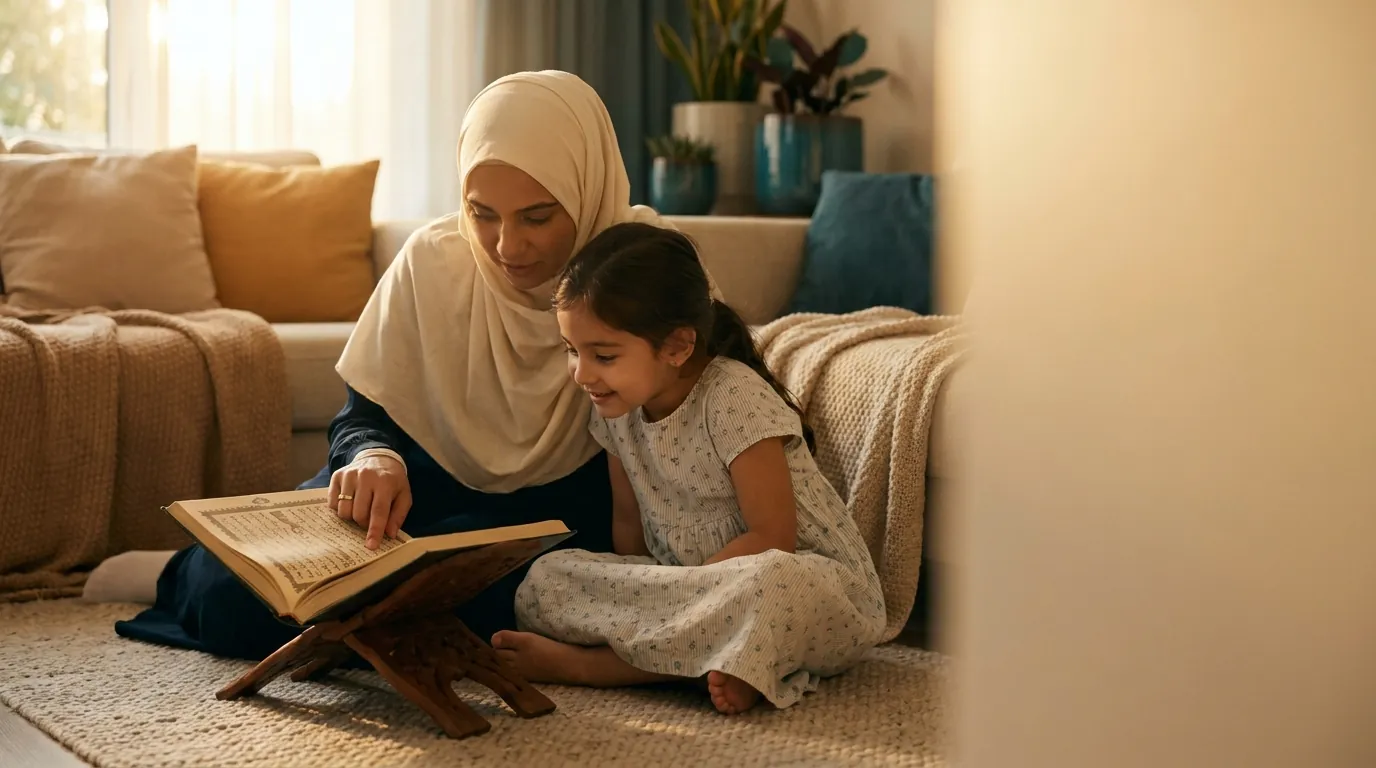
The most common reason parents fail at teaching their 6-year-old the Quran is not laziness or lack of love. It's that they're trying to teach a 6-year-old like an adult.
A 6-year-old has a 12–15 minute attention span for new academic material. Their phonemic awareness is still developing. They learn through repetition and play, not abstract explanation. If you push past those limits, the child resists, the parent gets frustrated, and the lessons stop after a few weeks.
This is a guide to teaching your 6-year-old the Quran in a way that actually works. From a teacher who has done this with several hundred children.
Start with realistic goals
For a 6-year-old, in the first three months of consistent practice, you should expect:
- Recognize all 28 Arabic letters by sight (out of context)
- Pronounce most letters correctly (some — the throat letters and emphatic letters — will take longer)
- Connect basic letter sounds into 2- and 3-letter words
- Read short ayahs with help
You should NOT expect:
- Fluent reading of full surahs
- Tajweed mastery
- Memorization of more than the shortest few surahs
- Long, focused lessons
Anything beyond the first list is a bonus. Start with these targets.
The 15-minute daily routine
This is the routine I give parents in my classes. It works because it's short, predictable, and the child knows what to expect.
Minute 1 · Salam and a hug. Sit together. Not at a desk — on the couch or the floor.
Minutes 2–5 · Letter recognition. Use flashcards or your phone. Show a letter. Child names it. If they don't know, you say it, then they repeat. No "wrong" — just "let's try again." 4–8 letters per session. Cycle through the same letters for a week before adding new ones.
Minutes 6–9 · Pronunciation practice. Pick 2–3 letters you've been working on. Say them slowly, child repeats. Look at each other's mouths. Make it a game — "show me how you put your tongue."
Minutes 10–12 · Connect letters into a word. Once the alphabet is solid, move to 2-letter words from Noorani Qaida. Read together. Read separately. Read in different voices. Make it silly.
Minute 13 · Recite something they know. Surah Al-Ikhlas, the Bismillah, anything they've memorized. Recite it together. End on a win.
Minutes 14–15 · Closing. Cuddle. Tell them you're proud. Mention what you'll do tomorrow. Make du'a together.
Total: 15 minutes. Same time every day, ideally before screen time so they're not distracted.
What works (and what doesn't)
What works
- Same time every day. Predictability lowers resistance.
- Physical proximity. Sit close. The Quran is bonding, not just instruction.
- Visible progress charts. A sticker for every day. A bigger reward for every 7 days.
- Audio repetition. Play recitation in the car. Play it during play. The brain absorbs even when not "studying."
- Praise the effort, not the outcome. "You worked so hard on that letter today" — not "You're so smart."
What doesn't work
- Lessons that drag past 15 minutes. Diminishing returns kick in fast at this age.
- Comparing siblings. "Your sister memorized this faster" destroys motivation.
- Punishment for mistakes. Quran should never be associated with shame.
- Lessons when they're tired. Right after school is a bad time. Saturday morning, before school, or after a snack and rest is better.
- Skipping days. Even 5 minutes is better than nothing. Momentum compounds.
When to bring in a real teacher
Three signs it's time:
- You're losing patience. Not occasionally — consistently. The child notices and starts dreading lessons. Better to outsource to someone who isn't emotionally tangled.
- The child has plateaued. They know the alphabet but you can't get them to read words together. A teacher with the right method (Noorani Qaida) gets them past this in 2–3 sessions.
- You're not sure how to teach the next thing. Sukoon? Madd? Shadda? Tajweed? If you don't know it cold yourself, you can't teach it.
Most children benefit from a real teacher within 3–6 months of starting at home. Not because the parent failed — because the curriculum gets technical and the relationship benefits from a third party.
The female-teacher question (for daughters)
For some families, a female teacher is a hard requirement once daughters are 7–8. That's a personal/cultural choice and a perfectly reasonable one. We have 4 qualified Hafizas on our team specifically for this.
For sons, gender of teacher is less commonly a constraint, but young boys often respond well to female teachers (more patient, less drill-sergeant) until they get older.
What to do if your child resists
A few possibilities. Try them in order:
Try a different time of day. Maybe right after school is too much. Try Saturday morning fresh.
Switch from screen-based to paper-based. Or the reverse. Sometimes the medium matters.
Take a 1-week break. Sometimes a child needs to miss it before they value it. After a week, return as if nothing happened.
Ask them. Not "do you want to learn the Quran" (the answer will be "no") but "what's one thing we could change about our Quran time that would make it more fun?"
Bring in a teacher. Sometimes a child will work for 30 minutes with a stranger when they wouldn't sit still for 5 minutes with a parent. That's normal.
Useful resources
- Noorani Qaida (any standard edition) — the foundational reader for kids
- Recitation by a child reciter — Mohammad Taha al-Junaid recordings are particularly engaging for kids
- Sticker charts — print or buy, kids respond to visible progress
- A free trial of our Quran for Kids program if you want to see what professional 1-on-1 looks like for a child your age
Free download
We have a free PDF guide: the first 10 surahs to teach your child, with their meaning and when they're recited.
→ Download: First 10 Surahs Guide (PDF)
About the author
Hafiza Saba Waqas is a Hafiza of the Quran with 6 years of online teaching experience. She specializes in girls and young children.
→ View profile · Book trial with Hafiza Saba Waqas
Ready to start?